The Honda ATC 250R: Off-Road’s Most Radical Machine
While the 350X was the crowd-pleaser, the Honda ATC 250R was something else entirely. From its introduction in 1981 through the end of the ATC era in 1986, the 250R stood apart as the most performance-focused, race-ready three-wheeler Honda ever built — a machine designed not for casual trail riding but for flat-out speed and competition.
Two Strokes, Full Send
The 250R ran a two-stroke 246cc engine at a time when four-strokes dominated the ATC market. That choice said everything about Honda’s intentions. Two-strokes are demanding, temperamental, and explosive — they reward skilled, committed riders with a hit of power that four-strokes simply can’t match in the same displacement. For desert racing, sand dunes, and competition, the 250R was untouchable.
Over its production life, the 250R received progressive refinements: improved suspension travel, lighter frames, revised porting and carburetion. Each year’s model was faster and more capable than the last. By 1985 and ’86, the final iterations were genuinely world-class off-road racers.
Desert Racing Royalty
The 250R dominated the SCORE and HDRA desert racing circuits throughout the mid-80s. Riders like Larry Roeseler and others piloted them to victories in events like the Baja 1000, putting the machine on the map not just as a recreational vehicle but as a serious competition tool.
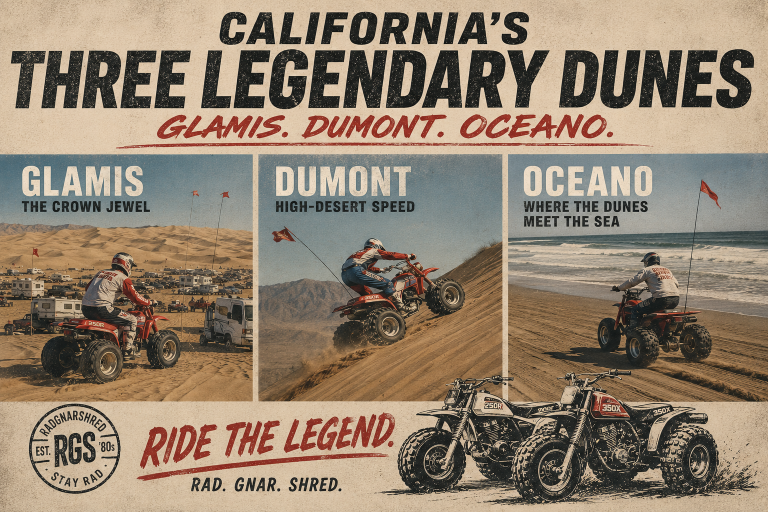
At the dunes — Glamis, Dumont, Oceano — the 250R was the weapon of choice for anyone who wanted to run hard and run fast. Its power-to-weight ratio made it unlike anything else in the class.
A Machine Ahead of Its Time
When the ATC era ended in 1987, the 250R went with it. But its legacy is arguably the strongest of any three-wheeler ever produced. Surviving examples are collected, restored, and raced today. Original condition 250Rs command serious money. The community of enthusiasts who maintain and race them is passionate, knowledgeable, and deeply connected to the machine’s history.
The 250R Slide Style Tee at RadGnarShred honors that legacy — a tribute to the most radical three-wheeler ever built, and the culture it helped create.