Glamis, Dumont & Oceano: A California Rider’s Guide to the legendary Sand Dunes Riding
Ask any three-wheel rider where the culture truly lives and the answer comes back in sand. The dunes are where 80s off-road culture went to cut loose — miles of open, shifting terrain with no trails to follow, no lines to hold, and nothing between you and the horizon but throttle. California is home to three of the most legendary dune destinations on earth, and each one has its own personality, its own history, and its own place in the story of alt sports.
Glamis: The Crown Jewel
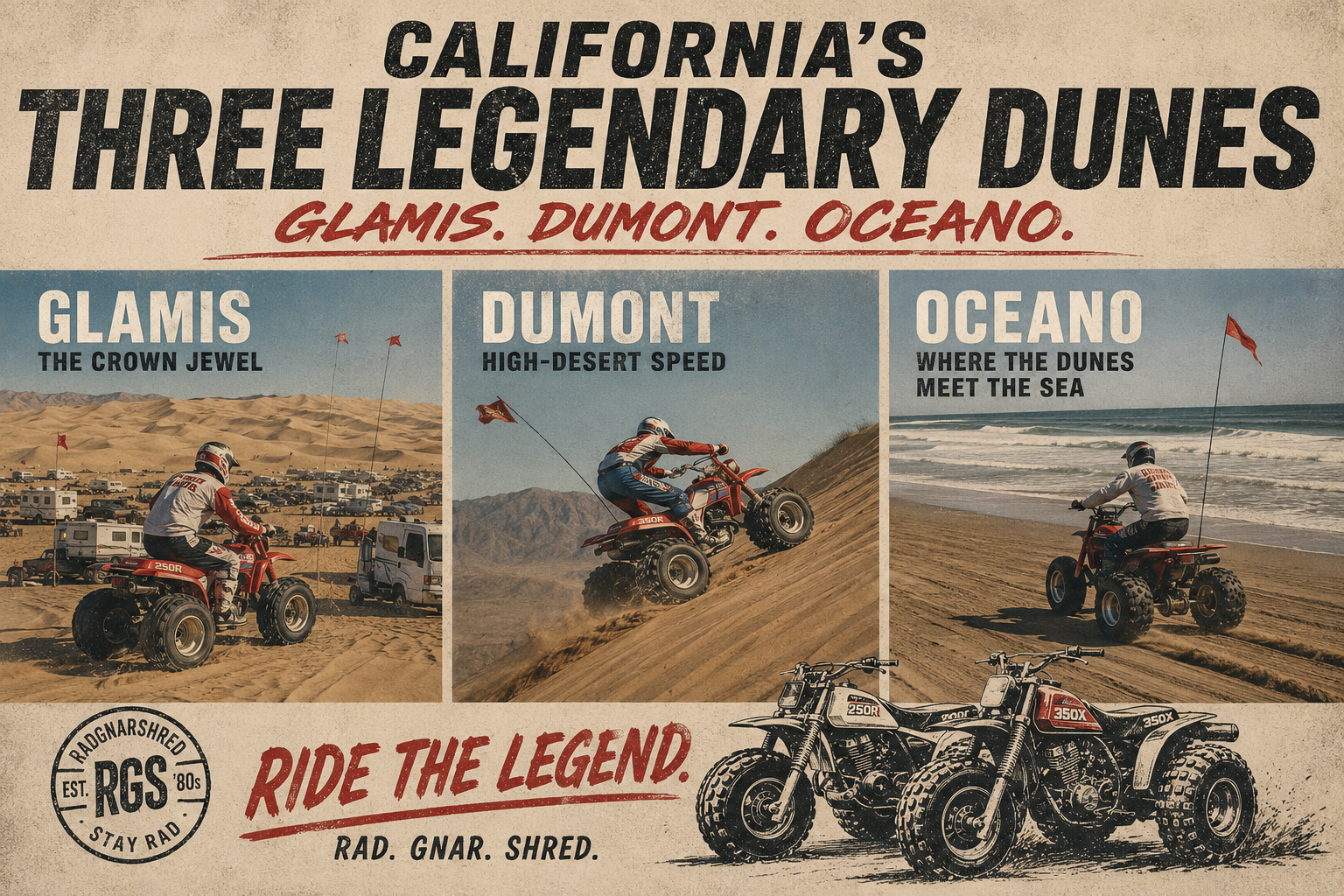
Officially the Imperial Sand Dunes Recreation Area — and known to generations of riders simply as Glamis — this stretch of the Algodones Dunes in southeastern California is the most famous off-road playground in the country. Running roughly 40 miles along the edge of the Imperial Valley, it offers everything from gentle rolling sand for beginners to the notorious steep faces that have humbled experts for decades.
Landmarks like Oldsmobile Hill, Gecko Road, and the Osborne Overlook are woven into off-road lore. In the 80s, Glamis was where ATC riders gathered by the thousands over holiday weekends — Thanksgiving remains the unofficial high holy day of the dunes — to camp, ride, and push their machines to the edge. The ATC 250R in particular found a natural home here; its two-stroke power-to-weight made it untouchable on the big faces.
Dumont: High-Desert Speed
Tucked between Baker and Death Valley off Highway 127, Dumont Dunes is smaller than Glamis but no less serious. What it lacks in size it makes up for in steepness — its famous Comp Hill is a punishing near-vertical climb that has long served as the ultimate test of horsepower and nerve. Riders who topped Comp Hill on a three-wheeler earned genuine respect.
Dumont’s high-desert setting gives it a rawer, more remote feel than the sprawling social scene at Glamis. It’s the kind of place where the riding does the talking. For the ATC 350X, with its broader four-stroke power band and planted feel, the varied terrain at Dumont was an ideal proving ground.
Oceano: Where the Dunes Meet the Sea
Oceano Dunes, on California’s central coast near Pismo Beach, is unlike anywhere else in the state — long the one place where you could legally ride directly on the sand at the ocean’s edge. The combination of packed coastal sand, salt air, and rolling dunes made it a bucket-list destination, and its reach from California’s population centers kept it busy year-round.
Oceano’s future as an off-highway vehicle area has been the subject of ongoing legal and regulatory battles in recent years, making it the most contested of the three. But its place in dune-riding history is secure — for decades it offered an experience no inland dune could match.
Reading the Sand
Dune riding is its own discipline. Unlike hardpack or trail, sand is constantly changing — wind reshapes the faces daily, and what was a smooth transition in the morning can be a razorback by afternoon. Riders learn to read the light, watch for the sharp shadow line that warns of a hidden drop-off, and respect the fact that momentum is everything. Paddle tires, the right gearing, and a strong power-to-weight ratio turn the dunes from intimidating to exhilarating.
It’s also why the ATC line earned such loyalty in the sand. Light, powerful, and nimble, three-wheelers could carve and slide across terrain that bogged down heavier machines. The “slide style” that defined 250R riding wasn’t a trick — it was the fastest, most controlled way to change direction on a steep sand face.
Ride the Legend
The dunes shaped the machines, and the machines shaped the culture. At RadGnarShred, that heritage lives on in the 250R Slide Style Tee and the 350X Rippen It! Tee — tributes to the machines that made Glamis, Dumont, and Oceano legendary. Whether you rode the sand back then or just wish you had, wear the era with pride. Rad. Gnar. Shred.